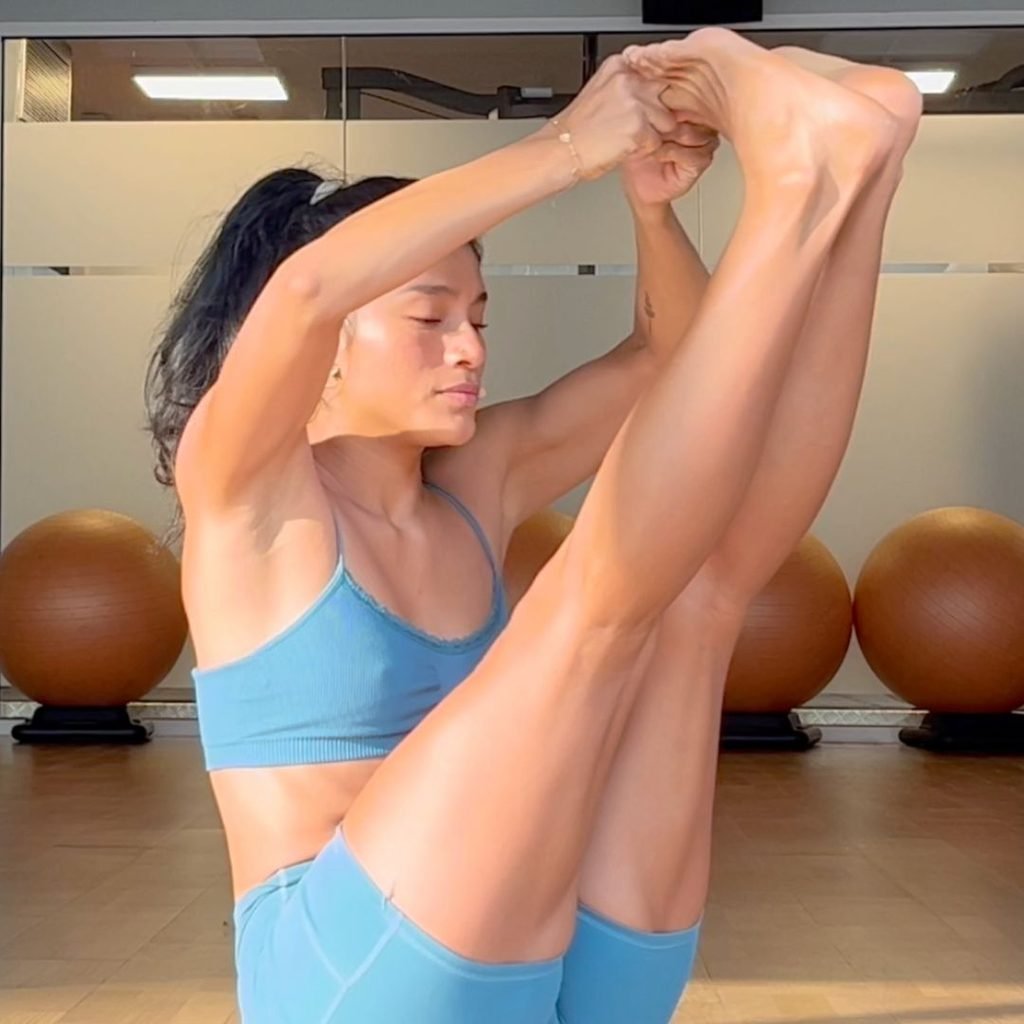
Why Do We Actually Do Yoga Postures? The Philosophy and Psychology Behind Asana
Why Do We Actually Do Yoga Postures? you could ask
If you asked most yoga students why they do postures, the answer would involve something about flexibility, strength, or stress relief.
If you asked most yoga teachers, you might get a slightly more refined version of the same answer. And all those answers are true, but let’s go deeper!
But if you asked the tradition that created these postures, the one that has been teaching them for over two thousand years the answer is something else entirely.
And understanding that answer changes the entire experience of being on the mat.
I’m Violeta, a psychologist and a certified yoga teacher who studied 500 hours in India,
In this post, I want to take you inside the actual philosophy of yogasana:
what it is, where it comes from, what the tradition says it does, and why that understanding transforms not just your practice but how you relate to your own body and mind.
“Yogasana is not exercise with a spiritual name. It is a systematic tool for developing higher awareness, of the body, the breath, and the mind.”
What Yogasana Actually Means, Patanjali’s Definition
The word asana comes from Sanskrit and means, simply, a seat or a posture.
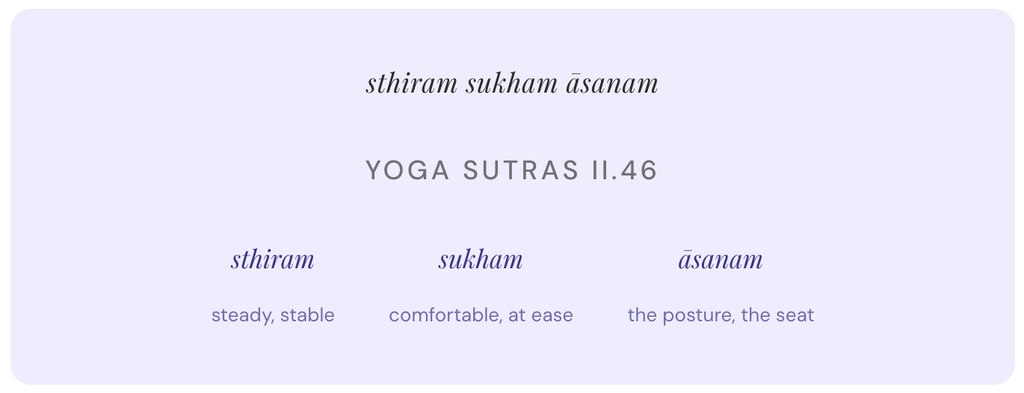
In the yogic tradition, the practice of postures is called yogasana and the most authoritative definition of it comes from Patanjali, the author of the Yoga Sutras, the foundational text of classical yoga philosophy.
Patanjali’s entire definition of asana is three words:
Notice what is absent from this definition: pain, challenge, advancement, performance.
What Patanjali describes is a state, of the body and the nervous system simultaneously. Steady. At ease. Present.
This is the aim of asana, not its prerequisite.
The practice is the process of learning to cultivate that state, progressively, in postures of increasing complexity, and ultimately, in life.
In Raja Yoga, the path of discipline that Patanjali describes the original purpose of asana was straightforward: to prepare the body to sit still long enough to meditate.
A body in pain, in restlessness, in chronic tension cannot enter the inward states the higher limbs of yoga require. Asana resolves that.
Hatha Yoga expanded this understanding significantly.
In Hatha Yoga, each posture is understood to operate simultaneously on multiple levels of the human system, not just the physical body, but the energetic and the mental body as well.
This is not a metaphor. It is a precise and systematic framework, and it maps onto what modern neuroscience and psychology are independently discovering about how the body, nervous system, and mind interact.
Three Levels of Work, Happening at the Same Time | Why do we do postures?
One of the most clarifying ideas in Hatha Yoga philosophy is that every asana works on three levels at once.
Understanding these levels changes what you’re doing every time you step on your mat.
Physical: Releasing chronic muscular tension, building structural integrity, improving circulation and organ function.
Energetic: Freeing the flow of prana through the nadis, the energy channels of the body, removing blocks that accumulate from stress and unprocessed emotion.
Mental: Dissolving psychological blocks, developing the capacity for self-observation, creating clarity of mind so that a different quality of life becomes possible
Most modern yoga classes teach the first level.
Some reach the second. Very few teach the third. This is not an indictment the first level alone has significant value.
But it means most practitioners are using only one third of the tool they’ve been given.
When you practice with awareness of all three levels, when the posture becomes not just a physical challenge but an opportunity for energetic release and psychological observation, the mat becomes something entirely different.
Not a place to perform. A laboratory for knowing yourself.
Prana, Energy Blocks, and What Your Tight Hips Are Actually Holding – why do we do postures
To understand the energetic level of asana practice, you need the concept of prana, the vital force that the yogic tradition says animates the entire body.
Prana flows through a network of channels called nadis, and when that flow is interrupted, through injury, stress, chronic tension, or unprocessed emotional experience, the result is a block: stagnation and the accumulation of what the tradition calls toxins.
Here is where the tradition and modern psychology converge in a way I find remarkable: what yoga calls a prana block, somatic psychology calls chronic muscular tension from unprocessed psychological material.
Different frameworks. Identical observation.
Chronic stress, emotional, psychological, relational, manifests in the body as holding patterns.
Tension in the neck. Tightness in the hips. Constriction in the chest. A breath that never quite reaches the belly.
From my own body
For months, I had difficulty breathing deeply.
Not dramatically, but a persistent sense that my breath was shallow, that there was a ceiling somewhere in my chest I couldn’t get past.
I went to the doctor. Every test came back fine. I was active, eating well, sleeping enough. Healthy by every measurable standard.
What was actually happening was that I was carrying significant psychological stress that had become structural.
The tension I was holding mentally had expressed itself through my breath pattern. My nervous system had learned to breathe in a way that kept me slightly braced at all times.
Once I understood this, not just intellectually, but through practice, through breath work, through the consistent experience of my own body on the mat, the pattern began to shift.
Steadily, as I gave the body enough experiences of safety and release to learn something different.
When you practice asana with breath awareness, where every movement is synchronized with an inhale or exhale, you are directly working with these holding patterns.
You’re not just stretching a muscle. You’re inviting the nervous system to release what that muscle has been holding on its behalf.
This is why people feel lighter after a genuine asana practice, not just tired, but genuinely lighter.
The prana moves more freely. The nervous system releases some of its chronic activation. And that release is felt not just in the body but in the quality of the mind that follows.
Chakras, Glands, and the Physiology the Tradition Always Knew
One of the most sophisticated aspects of yogasana is the relationship between the chakra system and the physical body’s glandular and nervous architecture.
In the yogic system, each chakra, energy center, corresponds to a specific nerve plexus and endocrine gland.
These are not abstract spiritual concepts.
They map onto physiological structures that anatomy has independently confirmed.
Specific asanas are designed to stimulate these centers, creating effects that cascade through the associated glandular and nervous pathways.
Chakra
Gland / Nerve Plexus
Key Asanas
Muladhara (Root)
Adrenal glands, pelvic plexus
Malasana, Baddha Konasana
Anahata (Heart)
Thymus gland, cardiac plexus
Chakrasana, Ustrasana
Vishuddha (Throat)
Thyroid, pharyngeal plexus
Sarvangasana, Matsyasana
Ajna (Third Eye)
Pituitary gland
Balasana, seated meditation
Sahasrara (Crown)
Pineal gland
Sirsasana (headstand)
When a teacher says a backbend opens the heart, they are describing both an energetic reality and a physiological one: the thoracic spine extension, the expansion of the chest cavity, the stimulation of the thymus gland, all of which have measurable effects on immune function, emotional regulation, and the nervous system’s capacity for connection.
Granthis: The Psychological Knots the Body Holds
In yogic tradition, a granthi is a point in the energetic body where prana is blocked and psychological patterns are crystallized.
They manifest simultaneously as physical holding patterns and as psychological tendencies, fear, defensiveness, attachment, dependency.
Working with granthis through asana and pranayama addresses both dimensions at once.
From a psychological perspective, this maps precisely onto how the nervous system stores and expresses psychological material.
Thoughts generate emotions. Emotions are physiological responses, they activate the nervous system, create hormonal cascades, and are expressed through the body.
When those responses are not processed — when the emotion is suppressed, overridden, or avoided in the interest of keeping functioning, the activation remains.
It lives in the tissue, in the breath pattern, in the postural habits of the body.
Crucially, the nervous system does not clearly distinguish between a real threat and an imagined one.
A memory, a fear, an anticipated loss, the body responds to these with the same physiological urgency as it would respond to an actual physical danger.
This is why trauma lives in the body. This is why anxiety is a physical experience. And this is why working with the body, through the body, is not an alternative to psychological healing but often a prerequisite for it.
When you practice asana and find that a particular posture generates a disproportionate emotional response, grief in a hip opener, anxiety in a backbend, a sudden desire to leave the room in a long hold, that is a granthi speaking.
“Every physical knot has a psychological counterpart. Asana works both simultaneously, and that is precisely why it can do what the mind alone cannot.”
Why I Don’t Teach Yoga as Exercise, And What Changes When You Stop
Understanding the philosophy of yogasana changes how I teach.
And in my experience, it changes how students practice, in ways that have nothing to do with how flexible they are or how long they’ve been on the mat.
When a student understands that the posture is not the point, that what the posture opens, releases, and develops in them is the point, they stop performing and start practicing.
The difference is not aesthetic. It is functional. A student performing a posture is trying to achieve a shape.
A student practicing a posture is using the shape as a vehicle for something deeper: awareness, breath, presence, the capacity to stay with difficulty without fleeing.
That second student, over months and years of consistent practice, builds something that no amount of physical training can replicate.
A nervous system that has learned to regulate itself. A mind that has learned to observe itself. A body that has learned to release rather than hold.
And they carry that into their relationships, their work, their sleep, their capacity to be fully present in their own life.
When you understand what asana is actually for | Why do we do postures?
You stop measuring success by the shape of the posture and start measuring it by the quality of your presence inside it.
You stop fighting the difficult moments and start getting curious about what they’re showing you.
You begin to notice, on the mat first, then off it, that how you respond to a challenging posture is exactly how you respond to a challenging situation in life.
And with that awareness comes something extraordinary: the possibility of choosing differently.
This is what my 12-week Ashtanga program is built around, not postures as endpoints but as tools.
Each week deepens the relationship between the physical practice, the philosophy behind it, and the psychological awareness it cultivates. Because you cannot fully understand what you’re doing on the mat without the tradition behind it.
And once you do, the mat becomes not just something you do a few times a week but a framework for how you see yourself and how you live.
“Asana is not a shape. It is a state. Steady, at ease, aware. That state is both the practice and the destination.”
If this opened something for you, a curiosity, a recognition, a different way of seeing what you’ve already been doing on the mat I’d love to invite you to go deeper.
And the 12-week program is where the full work begins: postures, philosophy, psychology, and the week-by-week experience of what happens when all three are practiced together, consistently, with intention.
The tradition has been waiting to offer this for a very long time. So has your body.
Ready to begin?
Start with a free class — or go deeper with 12 weeks of Ashtanga
Both are designed for exactly where you are right now.
Psychologist, certified yoga teacher trained in Kerala and Rishikesh, India (500h), and professional salsa and bachata dancer. Violeta teaches yoga online and in person at the intersection of movement, nervous system science, and yoga philosophy.
Session expired
Please log in again.
The login page will open in a new tab. After logging in you can close it and return to this page.