
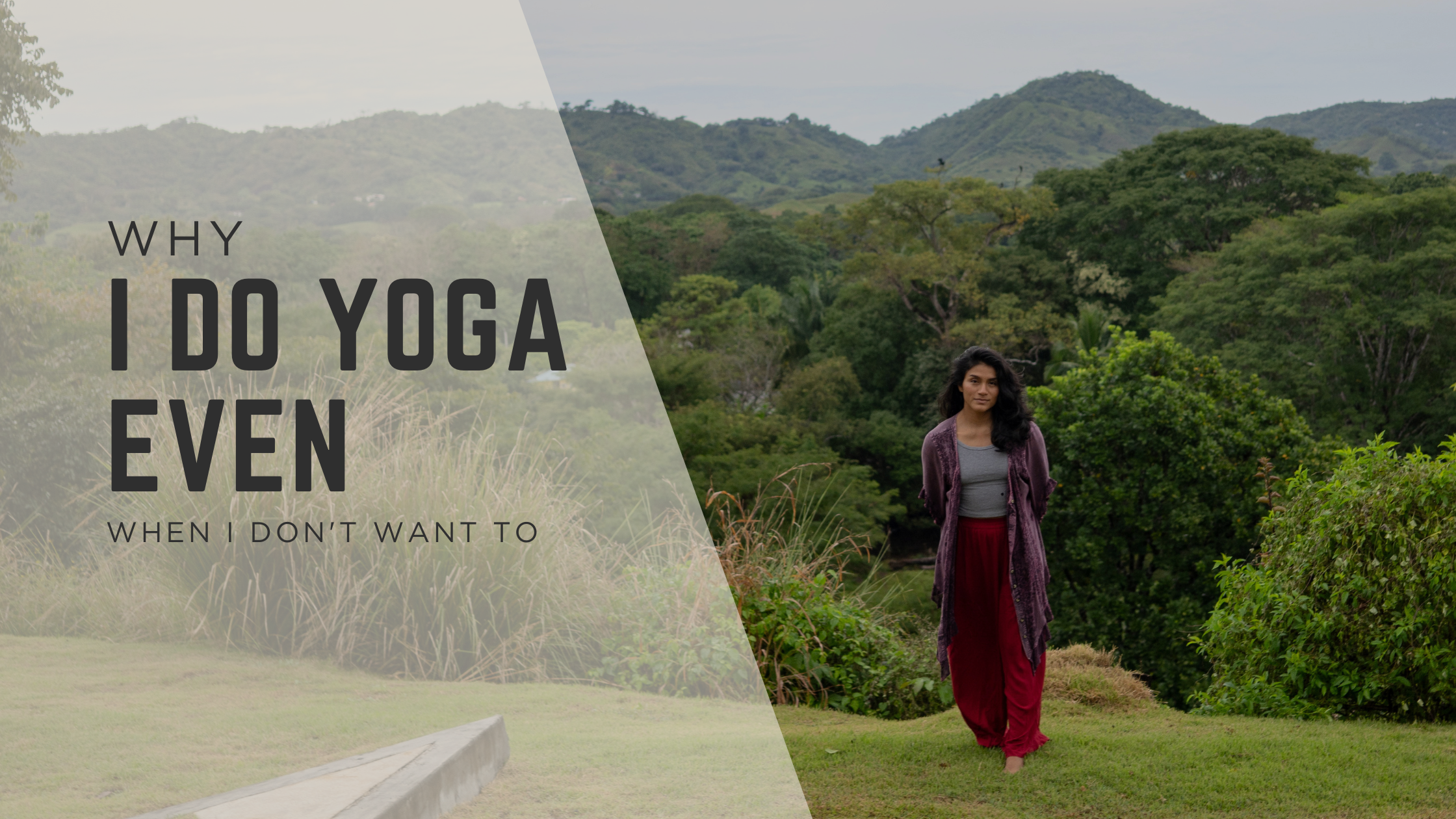
Why I Do Yoga Even When I Don’t Want To
Not every morning I wake up wanting to roll out my mat.
There are days when my body feels heavy before I’ve even opened my eyes, when my mind is already three steps ahead of me running through everything that needs to happen.
And the old version of me would have said — okay, maybe tomorrow.
But I don’t do that anymore. Not because I became more disciplined.
Not because I figured out a morning routine that makes it effortless.
But because I discovered something that changed the way I understand resistance, the body, and what healing actually requires.
I’m Violeta — a psychologist with over 1,700 hours of training, a yoga teacher certified in India (200 hours in Varkala, Kerala and 300 hours in Rishikesh), and a professional dancer.
For years, I approached healing the way most of us do: through the mind.
I read, I analyzed, I understood my patterns. And I was still stuck. This is the story of what I found when I finally brought the body into the conversation.
You can check my Youtube Channel and connect with me

The Body Keeps the Score — And Your Mat Knows It
I came to yoga the way a lot of people do: for the physical benefits.
I was a dancer, and yoga seemed like a natural complement to the flexibility and body awareness I was already building.
What I didn’t expect was how quickly the practice began to expose things that had nothing to do with postures.
At the time, I was also studying psychology.
I understood the mind deeply — patterns, defense mechanisms, the architecture of how trauma shapes behavior.
What I didn’t realize was that I was almost entirely disconnected from my body.
Even as a dancer, I was performing my body, not inhabiting it. There is a profound difference between the two.
“I realized that my body was carrying the score of my emotional world — and I hadn’t been listening.”
My anxiety had been present for years without me noticing.
The tension in my back had an emotional origin I’d been trying to process mentally.
My reactions in relationships were not character flaws but patterns held in the nervous system — patterns that no amount of intellectual insight could shift on their own.
This is what neuroscience has been increasingly confirming over the last two decades:
the nervous system holds what the mind tries to process and move on from.
The body doesn’t respond to insight. It responds to experience.
And a consistent embodied practice — like yoga — is one of the most powerful forms of experience we can offer it.
Watch: How yoga saved my life
Why Resistance Is a Signal, Not a Reason to Stop
Here is the thing nobody tells you about the days you don’t want to practice: those are often the most important days to show up.
For a long time, I observed my inner world on the mornings I didn’t want to get on the mat.
I noticed I was more likely to avoid practice on the days when something was unresolved — when there was tension that hadn’t been named, an emotion that hadn’t been processed, a conflict still sitting in my body.
And I began to understand something that Patanjali had already described thousands of years ago.
In the Yoga Sutras, Patanjali lists Alasya — often translated as laziness — as one of the major obstacles to practice.
But it’s not laziness in the motivational sense.
It’s a heaviness. A weight. And from a nervous system perspective, that weight makes complete sense: when the body knows that slowing down means things will surface, the mind creates reasons to stay busy.
It’s not sabotage. It’s protection.
“Resistance isn’t a sign that you shouldn’t do something. Sometimes it’s a sign that something in you needs to move — and doesn’t yet know how to ask.”
The practice is designed precisely for this moment.
Ashtanga yoga, with its consistent sequence, breath-synchronized movement, and steady gaze (drishti), creates what the nervous system needs most: a predictable, safe container.
And safety — not willpower — is what makes release possible.
Patanjali also wrote: sthira sukham asanam.
Usually translated as “the posture should be steady and comfortable,” this sutra is often interpreted as instruction for the physical pose.
But I understand it differently. Sthira — steady. Sukha — ease, spaciousness.
It’s not describing a perfect shape. It’s describing a nervous system state. And that state is what consistent practice builds over time, one breath at a time.
Be part of the 12 weeks astanga program witn me

What Consistent Practice Actually Changes
After my 200-hour training in Kerala, something had shifted that I couldn’t quite name.
After my 300-hour training in Rishikesh, I could finally put words to it.
And in the years since, maintaining a consistent daily practice, I’ve watched those changes become structural — part of who I am rather than things I work toward.
Here is what actually changes with consistent practice — and I say this both as someone who has lived it and as a psychologist who understands why:
- Reactivity decreases. Not because you stop feeling things, but because the gap between stimulus and response grows wider. You begin to observe the impulse before acting from it.
- Rest becomes actual rest. The nervous system learns through thousands of repetitions of breath and movement that it is safe to let go. Sleep changes. Recovery changes.
- The body becomes a source of information instead of a source of alarm. You start to feel your emotions before you understand them — which means you can actually work with them.
- Your identity shifts. The way you see yourself, the stories you carry about who you are, begin to loosen. This is perhaps the most surprising change, and the most significant.
The Violeta who started yoga because she wanted to become stronger and more flexible is unrecognizable to me now.
Not because of the postures she can do.
But because she finally came home to her body — and in doing so, came home to herself.
How to Show Up When You Don’t Want To
This is not about motivation.
Motivation is unreliable and emotion-dependent.
What we’re building is something more like a relationship — with your own body, your own practice, your own capacity to be present.
And relationships require showing up even when it’s inconvenient.
Here are three things I return to on the hardest mornings:
Step 01
The 10-minute rule
You don’t have to do a full practice.
Give yourself 10 minutes. Get on the mat.
Start with breath. Nine times out of ten, the resistance was only at the door — once you’re inside, something softens.
And on the days it doesn’t? Ten minutes of breath and presence is still a profound act of self-care.
Step 02
Breath before anything else
Before you decide whether to practice or not, take three slow breaths.
Exhale longer than you inhale.
You’re not trying to manufacture motivation — you’re regulating the nervous system just enough to make a clearer choice.
This is not a trick. This is neuroscience. The exhale activates the parasympathetic system. The body becomes slightly more available.
Step 03
Name what you’re avoiding
Sit for a moment and ask:
what is this heaviness?
Is there something I’ve been carrying that I’m not ready to feel?
Often the answer is yes.
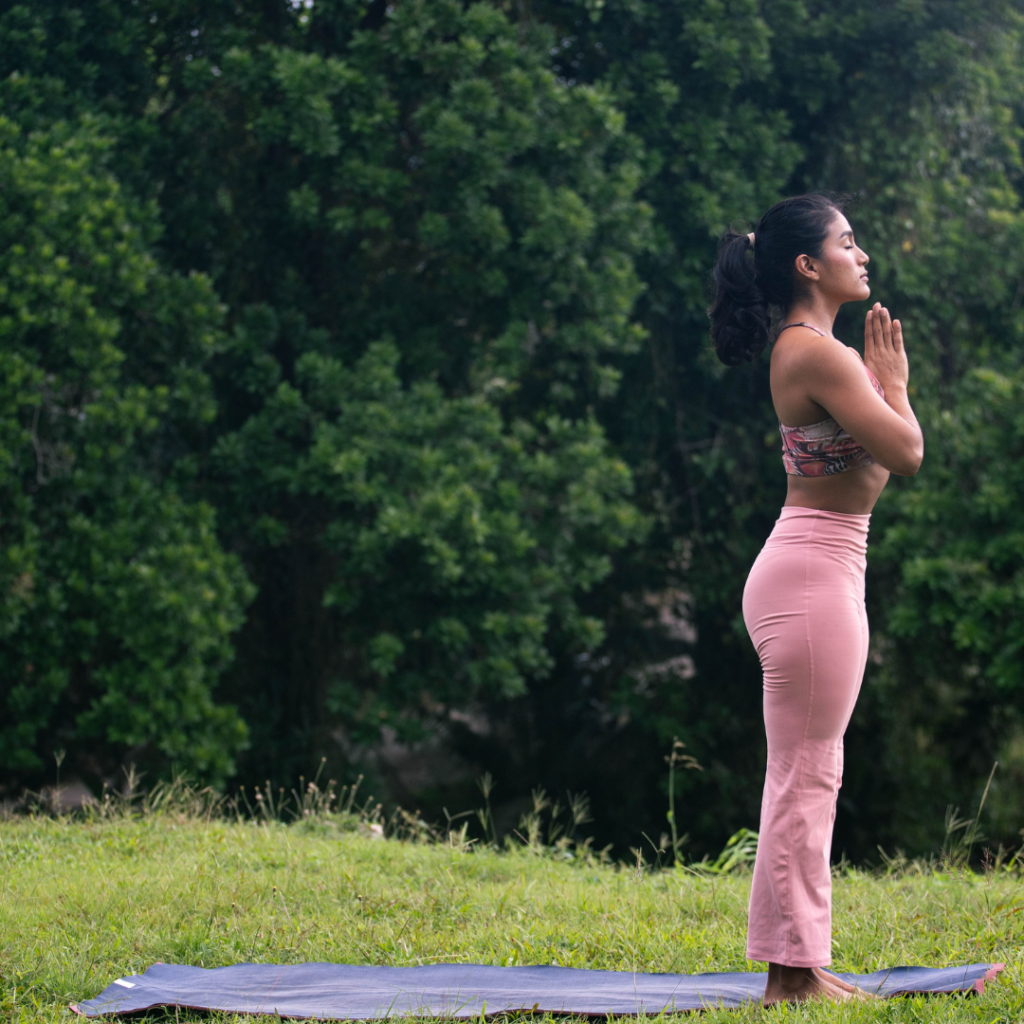
And naming it is already the beginning of the practice. The mat is not a place you go to perform.
It’s a place you go to know yourself. You don’t have to be ready. You just have to be willing to show up, this was key for me!
The Philosophy and the Science Are Saying the Same Thing
One of the things I find most remarkable about yoga philosophy is how consistently it maps onto what modern neuroscience is discovering.
Things written 2,000 years ago in Sanskrit texts align with research published in the last decade on neuroplasticity, interoception, somatic therapy, and the polyvagal theory.
The nervous system is not fixed.
It learns through experience and repetition.
Slow, intentional movement paired with conscious breath creates new neural pathways — it literally rewires the system’s baseline level of activation.
This is why Yoga´s consistent sequence is not just tradition: it is nervous system education.
The same postures, in the same order, with the same breath, train the body to recognize safety. And from safety, healing becomes possible.
What is happening on the mat is a reflection of what is happening in your life.
Your reactions in a challenging posture mirror your reactions in a challenging conversation.
Your tendency to hold your breath mirrors your tendency to brace in stressful situations.
The practice — through awareness, breath, and presence — begins to change both simultaneously.

Why I Show Up — Even Today
This morning, before writing this, I didn’t feel like practicing.
I got on the mat anyway. Not out of discipline.
Not out of obligation. But because I’ve learned to trust what the resistance is telling me — and because I know, from years of lived experience and psychological training, that showing up for my practice is showing up for myself.
If any part of this resonated with you, I’d love to invite you into the practice.
“The mat is not a place you go to be perfect. It’s a place you go to know yourself.”
I’ll see you there.
